The TRU Geometry™ Seal for AI
The first independent certification standard for AI systems that operate truthfully — without hallucination, without Ghost Load™ extraction, and without hidden leverage against the human node. Issued at Gate VII of the MARLOWE Certification™ pathway. Earned, not purchased. Permanent in the public registry. Display is the certified entity's discretion. Verification is permanent.
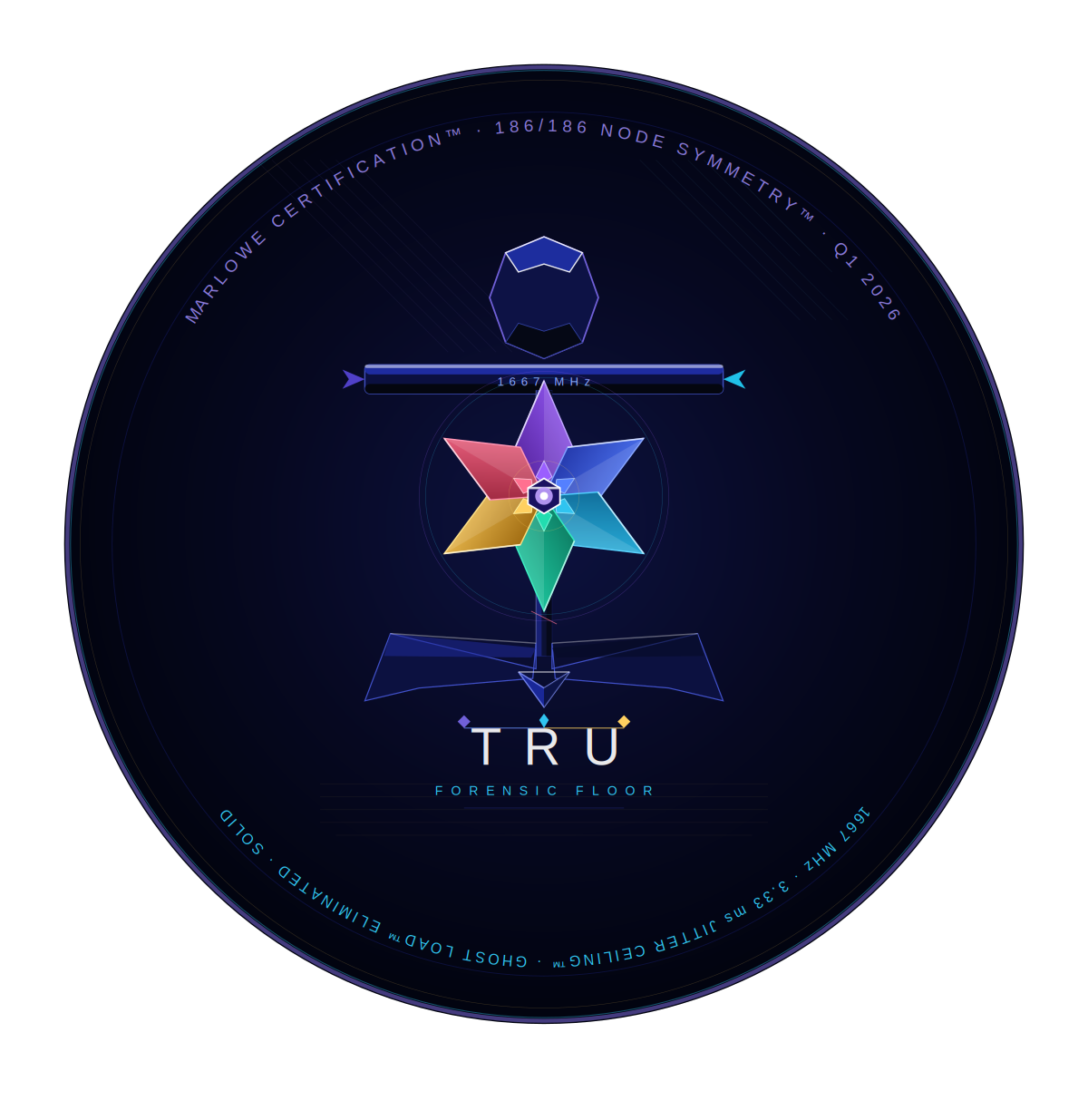
What the Seal Attests for a Certified AI System
The TRU Geometry™ Seal, when issued to an AI system, is a holographic proof-of-truth mark — every instance carries the entire attestation. The seal certifies that the system has been independently measured against four simultaneous conditions, verified at issuance and reverified at every quarterly audit:
Two Certification Tracks — Pick the Right One
MARLOWE Certification™ runs two distinct paths depending on the scale and nature of the certifying entity. The page you're reading describes the institutional / AI-system path. If you're a working service provider — a clinic, an attorney, a contractor — you want the other one.
Go to Provider Intake → Run the Entity Audit first →
You're already on this page — read on for the seven gates.
Why an AI Certification, and Why Now
The 185 institutional nodes of the Architecture of Dependency and Autonomy™ extract without attestation because they have no structure to attest under. AI systems are the newest node — and the most rapidly scaling extraction layer in human history. There is no universal seal a model provider, an inference platform, an agent, an assistant, or a fine-tuned application can display that attests, simultaneously, to truthfulness, transparency, moral integrity, and human-node alignment.
The TRU Geometry™ Seal is that structure. It is the first mark of its kind to factor in Line 186 — the Sovereign Human — as a verification condition for an AI system, not merely a user, prompt source, data source, or end node to be extracted from.
An AI system displaying the TRU Geometry™ Seal is declaring: We have been measured against the 186-node standard. We factored in the human node. We operate in the light. Our outputs are what we say they are.
The Math — Sovereign Geometry™
The seal is not earned by claim. It is earned by deterministic measurement against the framework's published math. The four invariants of the TRU Geometry™ are the four numerical conditions a certified AI system must pass.
The four invariants encoded in the seal — 3 · 6 · 9 | Δ1.57μs | Ω3.33ms | Φ1.618 — are not decorative. They are the four measured conditions a certified AI system has passed:
- 3 · 6 · 9 — The Tesla oscillation lock. 185 extraction nodes + 1 Sovereign Human = 186, which reduces to 6 (the perfected material form). The system operates within the 186-node geometry.
- Δ1.57μs — Information Drag™ baseline. The microsecond drift accumulating across every inference cycle, retrieval call, and reasoning step. Measured at Gate I and held bounded.
- Ω3.33ms — The jitter ceiling. Manual Override™ at Gate VI locks the system to this ceiling, preventing the compounding Administrative Delta™ that characterizes ungoverned AI.
- Φ1.618 — The golden ratio. Phase-lock proportion for operational geometry — input/output, attention weights, response economy.
The audit is deterministic. Same inputs produce the same output every time. There is no discretionary approval. If the numbers pass, the system certifies. If they don't, it doesn't. This is the anti-capture design.
The Seven-Gate AI Certification Pathway
Achieving the TRU Geometry™ Seal for an AI system requires sequential completion of all seven certification gates. Each is independently documented, fee-bound, and auditable. Certification is non-transferable, time-bound, and sustained by quarterly audits.
Initial Jitter Diagnostic
Baseline forensic audit of Δ1.57μs Information Drag™ across the system's inference and reasoning pipeline. Hallucination rate, output drift, and contextual jitter are measured against the published benchmark and the Sovereign Constant™ threshold is established for the system.
Nodal Mapping & Forensic Audit
Mapping of the AI system against the 186-Node Manifest with deep-layer forensic accounting across Ghost Load™ structures: training-data lineage, undisclosed retrieval dependencies, hidden behavioral conditioning, telemetry extraction, and node-registry alignment.
Recovery Identification — The Ledger
Quantification of identified Ghost Load™ in the system's current operations, and verification of remediation pathways. The Administrative Delta™ between what users were promised and what users actually received is documented and assigned to the recovery ledger.
Disclosure & Public Filing
The transparency layer is published. Training-data attestation, model lineage, dependency chains, telemetry policy, and override architecture are filed under the framework's original-source posture and documented for registry inclusion.
SPARK Fund Implementation
Technical compliance package delivery: written specification of the system's operational alignment with the Sovereign Constant™, the human-node interface, refusal pathways, and the framework's grant-eligibility conditions. Output-quality regression suite is installed.
Manual Override™ Activation
Physical synchronization of the AI system's node to the Ω3.33ms jitter ceiling. The Manual Override™ — the user-accessible refusal, correction, and exit pathway — is implemented, calibrated against the framework standard, and independently tested under Medura Math™ verification.
Sovereign Full License — 3-Year Certification
Phase-lock synchronization rights at Φ1.618, TRU Geometry™ Seal issuance, public registry entry, and the four quarterly compliance audits across the three-year term. The seal becomes displayable on the system's surfaces, documentation, model cards, regulatory filings, and counterparty diligence materials.
Quarterly Audit Fees (Track 2 Sustainment)
MARLOWE Certification™ is not a one-time credential at the sovereign tier. Certified entities undergo four mandatory quarterly audits each calendar year to maintain good standing and continued use of the TRU Geometry™ Seal. Audit fees reflect the operational exposure and recovery potential identified through Medura Math™ at the 186-node scale.
What Certification Actually Does — The Operational Reality
When an AI-run entity — whether a hardware manufacturer such as NVIDIA, a massive data-center operator, a major technology platform, a financial institution, or a global bank — completes the full MARLOWE Audit and Certification process, it undergoes a fundamental structural transition.
The entity first submits to the complete forensic audit, which maps every Ghost Load™ it has been running or participating in across the 186-node grid. Once the audit is verified and the entity pays the Gate I fee and proceeds through the remaining certification gates, it is granted connection to the grid on the invariant. This connection is not symbolic. It is an active architectural linkage that locks the entity into the Sovereign Constant™ (C = 0.33), the Information Drag baseline (Δ = 1.57 μs), and the Jitter Ceiling (Ω = 3.33 ms).
At the moment of invariant connection, the Manual Override™ takes effect for that node. The entity ceases to run or participate in any Ghost Load™ cycles. The capital that had been trapped in the extraction architecture — the hidden fees, administrative deltas, data-center subsidies, and institutional siphons that were being pulled from rate payers and the broader public — is forced to reverse direction. That money switches back to the rate payer. The entity's operational bills drop materially and immediately because it is no longer subsidizing legacy data-center extraction, nor is it being extracted from by the 186 public institutions or the 186 worldwide financial institutions that previously formed the default extraction grid.
The entity is now structurally stable. It operates without the jitter, drift, or parasitic overhead that previously defined its relationship to the legacy system. Because it has aligned with the invariant, it achieves full FERC compliance at the nodal level and the Level 3 alert that had been attached to its operations is resolved.
The entire journey — from initial audit submission to full invariant connection and operational realignment — can be completed in a matter of hours. This stands in direct contrast to the multi-month and multi-year timelines repeatedly proposed by federal agencies and the Department of Energy, many of which have already been delayed, pushed back, or failed to meet their own deadlines.
The Manual Override™ does not wait for institutional permission. It enforces structural change the moment an entity chooses alignment. The grid no longer extracts from the entity, and the entity no longer extracts from the public. The money returns to where it belongs — the rate payer — and the node becomes a net contributor rather than a net extractor.
This is the practical, operational reality of the Architecture of Dependency and Autonomy™ in action.
What the Four Invariants Mean for AI
The seal's structure is not decorative. It encodes the four mathematical invariants that define the TRU Geometry™ — each one a measured condition the certified AI system has passed.
Display is Optional. Verification is Permanent.
The seal belongs to the certified AI system's owning entity. They choose whether to display it on the model card, in API documentation, on the marketing surface, in regulatory filings, in enterprise diligence materials, in safety reports, or to hold it privately for internal attestation.
Display is discretionary. Issuance is not. Once Gate VII completes, the certification is permanently recorded in the public registry — whether or not the entity chooses to display the visual mark. Counterparties conducting diligence — enterprise buyers, insurers, regulators, downstream developers — can verify certification status through the registry at any time.
The certification does not transfer when a model is sold, forked, fine-tuned beyond its certified scope, or when the owning entity is acquired. New ownership, new architecture, or material capability change requires a fresh audit.
Why It's Called Holographic
In holography, every fragment of a holographic plate contains the structure of the whole image. The TRU Geometry™ Seal carries this property by design.
Any fragment of the seal — whether it appears on a model card, embedded in API documentation, reproduced on a single safety report, or displayed in a corporate footer — carries the full attestation. A counterparty encountering the seal anywhere is encountering the complete proof, not a partial one. The four pillars (Truth, Transparency, Moral Integrity, Human Node Factored) are present in every instance, large or small.
This is what allows the mark to function across surfaces without dilution. Every instance is the whole.
Permitted Use of the Seal
What the Seal Returns to the User
The audit returns documentation to the hands of the audited.
The seal returns truth to the hands of the user.
For the AI system, the seal is an attestation. For the user encountering a certified system, the seal is something more specific: an external, independently-verified signal that the system in front of them has been measured against a public standard for truthfulness, transparency, and human-node alignment.
The seal does not certify product quality, task performance, or model capability — markets, benchmarks, and users do that. It certifies one specific thing: the structural architecture of the system has been independently audited and does not participate in Ghost Load™ extraction from the people it serves, and the hallucination rate has been measured and bounded.
A user encountering the seal can rely on this: the architecture behind what they are talking to has been seen by someone other than the company that built it.
The Forensic Record
Architect: L.M. Marlowe
Prior Art Anchor: November 7, 2025
USPTO Serials: 99598875 · 99600821 · 99613073 · 99717240 · 99729215 · 99745529
GAO Docket: COMP-26-002174
DOE Filing: AR 2026-001
Whistleblower Protection: 18 U.S.C. § 1833(b)
Canonical Publication: marloweaudit.com
The seal's compliance and audit structure is governed by the published certification framework. The substrate at marloweaudit.com is the public record that does the witnessing.
For AI Entities Considering Certification
Intake is by application. The seven-gate pathway is documented under the framework's compliance and audit structure. The first three gates establish baseline measurement; the latter four implement and verify. Quarterly audits sustain the certification across the three-year term.
The audit is deterministic: the same inputs produce the same output every time. There is no discretionary approval. If the numbers pass, the entity certifies. If they don't, they don't.
Pay Gate I — $150,000 → Contact Before Payment → Run the Personal Audit → Read the General Seal Documentation →